Rendered from the repository — the file stays the source of truth.
Scenarios — the +1 view
Status: Snapshot as of 2026-08-18 (session C5). Four concrete use cases that exercise the other four views. Every trace below actually ran: the evidence is the end-to-end verification records in
handovers/2026-08-18-session-a3-ingestion.md(A3, PR #15) andhandovers/2026-08-18-session-a4-grounded-chat.md(A4, PR #24), run against a local Supabase stack and the real Scaleway Generative APIs.
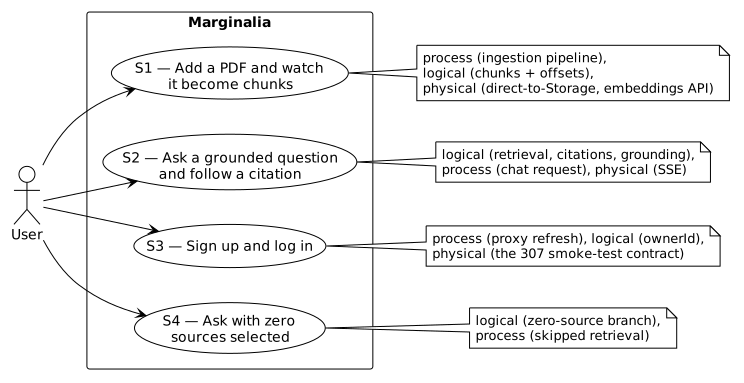
Diagram source: product/architecture/diagrams/scenarios-use-cases.puml.
The two process-view sequence diagrams (process-ingestion.puml,
process-grounded-chat.puml) are the detailed traces behind S1 and S2.
S1 — Add a PDF and watch it become chunks
What A3 verified: the 15-page arXiv paper 1706.03762 (“Attention Is All You Need”), uploaded through the browser.
- From the add-sources dialog, the browser uploads the PDF directly to
Supabase Storage under
<userId>/<uuid>/<filename>(D-5). addFileSourceActionrunsrequireUser()and the 20 MB / 50-source guards, creates the source row (statuspending), and returns at once —after()detachesingestSource().- The pipeline flips the status to
processing, downloads the bytes (service-role client), parses per page with unpdf, chunks per page, embeds in batches (2000 dims asserted), writes the chunks atomically viareplaceChunks, and setsready. - The sources panel’s 2.5 s poll shows the spinner, then the Ready state.
(The full interaction is the process-ingestion.puml sequence diagram in
the process view.)
Recorded outcome: status ready, 35 chunks with page_number
1–15; across the session’s whole corpus, 90/90 chunks satisfied
vector_dims(embedding) = 2000 and the offset invariant
substring(content, char_start+1, char_end−char_start) = text. The
failure path was exercised too: a 404 URL produced a Failed badge with
error_message “the page could not be fetched (HTTP 404)”.
Views exercised: process (the ingestion pipeline and polling), logical (sources→chunks, offset invariant), physical (direct-to-Storage upload, embeddings API), development (the same pipeline runs in tests with injected fakes).
S2 — Ask a grounded question and follow a citation
What A4 verified: “What writing system developed in Mesopotamia…?” against an ingested Wikipedia source.
- The user selects sources; the browser POSTs to
/notebooks/[id]/chat. - Retrieval: the question is embedded, then
hybridSearchChunksruns (HNSW + full-text, RRF-fused), restricted to the selected ready sources. streamTextstreams the answer token-by-token over SSE; at the first[1]adata-citationpart streams alongside and the chip renders with its title/location tooltip.- On finish, the assistant message and its citations rows (ordinal, quote) persist in one transaction.
(The full interaction is the process-grounded-chat.puml sequence diagram
in the process view.)
Recorded outcome: a streamed markdown answer citing [1]/[7]; SQL
showed citations rows whose ordinal and quote resolved to real Mesopotamia
chunks. Selection restriction held: with only “River valley notes”
selected (counter “1 source”), the answer cited only that source — SQL
confirmed the unselected source was never cited. After a reload, the full
history rehydrated with chips whose data-chunk-ids matched the citations
table exactly. (Chip → viewer scroll navigation is A5’s in-flight work; the
chips already carry the chunk/source ids for it.)
Correction (2026-08-18, session C8): shipped — A5 (PR #29) wired chip → viewer navigation with the cited passage highlighted and scrolled into view, and B3’s deployed E2E (PR #36) re-ran this whole trace — including the click-through and an audio overview — against the hosted stack on the public URL.
Views exercised: logical (retrieval abstraction, citation invariants, grounding contract), process (the whole request sequence), physical (SSE through the platform, Generative APIs), development (RRF and marker extraction are unit-tested modules).
S3 — Sign up and log in
What A2/A4 and the deploy smoke test verify.
- The
/signupform submits to thesignUpserver action, which callssupabase.auth.signUp;@supabase/ssrwrites the session cookies. - Redirect to
/(the library page), whererequireUser()re-validates. - On every later request,
proxy.tsrunsgetClaims()— verifying and refreshing the JWT, rotating cookies; unauthenticated hits on protected paths redirect to/login. The redirect is optimistic only — every action and route re-checks viarequireUser().
Recorded outcome: A4’s route-guard checks by direct fetch:
unauthenticated → 307 to login (the chat handler itself returns 401), a
foreign notebook → 404, invalid body → 400 — all readable text, no stacks.
The deploy workflow’s smoke test encodes the same contract: anonymous
GET / on the production container must return 307
(.github/workflows/deploy-webapp.yml).
Views exercised: process (proxy refresh flow), logical (ownerId as the scoping key), physical (auth behavior is the deploy’s health check), development (route-access rules are a pure, tested module).
S4 — Ask with zero sources selected
What A4 verified: all sources unchecked (“0 sources”), a question about the Hanging Gardens.
- The browser POSTs to the chat route with
selectedSourceIds: []. prepareGroundingskips retrieval entirely — no embedding call, no search; the zero-source system prompt is used instead.- The answer streams from general knowledge with the mandated disclosure (“this reply comes from general knowledge, not your sources…”); citation markers are forbidden in this mode.
Recorded outcome: the answer carried the explicit disclosure, rendered no chips, and created no citation rows — the grounded/ungrounded boundary (NF-01’s “clear behaviour when evidence cannot be found”) is visible to the user, not silent.
Views exercised: logical (the zero-source branch of the grounding
contract), process (the skipped-retrieval path), development
(buildZeroSourceSystemPrompt and the empty-selection path are
unit-tested).