Rendered from the repository — the file stays the source of truth.
Development view — how the code is organized
Status: Snapshot as of 2026-08-18 (session C5). Describes the monorepo layout, the layer rule, testing, toolchain, and CI as merged. The authoritative working rules live in the
AGENTS.mdfiles; this page maps them, it does not replace them. Extended 2026-08-18 (session C6): dependency overview with per-dependency rationale added below.
Update (2026-08-18, session C8): refreshed in place for the merged board — the test count (154 as of A6, PR #49), the removal of the PGlite dev-dependency rows (A7 implemented D-9, PR #33), and the two Terraform providers added by B4 and B5 in the infrastructure table.
Monorepo layout
Bun-managed workspaces (apps/*, packages/* — root package.json):
notebooklm-clone/
├── apps/
│   ├── webapp/          Next.js fullstack app (the product)
│   ├── docs/            Astro static docs site (this site)
│   └── marketing/       Astro static marketing site
├── packages/            shared workspace packages (still empty)
├── supabase/            migrations (ONE timestamp-ordered timeline:
│   │                    drizzle-generated + hand-written), config.toml
├── infrastructure/      Terraform for Scaleway + the hosted Supabase
│   │                    project (import-only, B5)
├── product/             scope, feasibility, security, history, these views
├── handovers/           one note per working session
└── .github/workflows/   ci.yml, deploy-webapp.yml, deploy-static-sites.yml
The layer rule (DDD path)
Every webapp feature must be traceable straight through
(apps/webapp/AGENTS.md):
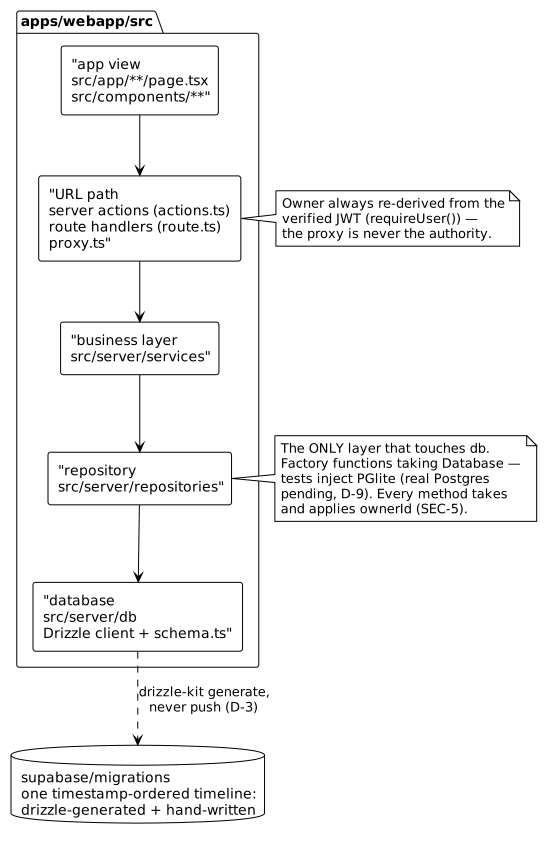
Diagram source: product/architecture/diagrams/development-layers.puml.
Where it is enforced: by convention and review, not tooling — the rule
is stated in apps/webapp/AGENTS.md (repository pattern mandatory; UI,
route handlers, and actions never import db directly) and checked in
every PR review. The code shape supports it: repositories are factory
functions taking a Database, so services accept injected dependencies and
tests never need the real connection; everything under src/server/ is
server-only; the ownerId parameter on every repository method is the
standing SEC-5 review item.
Testing strategy
bun testfrom the repo root sweeps all workspaces (rootAGENTS.md). 154 tests pass as of A6’s merge (PR #49; the count was 80 when this page was written at A4 — updated by C8).- Pure logic (chunking offsets, grounding/marker extraction, route access) is tested directly — the modules are deliberately framework-free.
- Database-backed tests (repositories, ingestion pipeline, hybrid search)
run against a real Postgres with pgvector
(
src/server/db/create-test-database.ts, D-9): each test file gets its own throwaway database — locally on the Supabase stack’s Postgres (supabase start, no extra setup), in CI on apgvector/pgvector:pg17service container, overridable viaTEST_DATABASE_URL. The actual migration timeline fromsupabase/migrations/is applied (the hand-written pgvector migration plus drizzle’s journal), so tests also validate the generated SQL. Supabase-only migrations (RLS, storage buckets) are intentionally not applied — authorization under test is the app-layer scoping. I/O boundaries (embedder, file loader, HTML fetcher) are injectable fakes; no test touches the network. - D-9 history (
product/feasibility.md, decided 2026-08-18 in PR #23, implemented the same day by session A7): these tests originally ran on PGlite (in-process WASM Postgres), but PGlite under Bun exits 99 despite passing tests and its cold WASM init blew CI hook timeouts;ci.ymlcarried two interim workarounds until A7 removed them.
Toolchain
| Tool | Role | Rule |
|---|---|---|
| Bun | package manager, script runner, test runner | Never pin versions from memory — always bun add (root AGENTS.md); production webapp runtime is Node, not Bun (D-1) |
| mise | pins Bun, Terraform, Supabase CLI (mise.toml) |
mise exec -- <tool> when not activated |
| varlock | env schema (.env.schema, committed) |
secrets only in Proton Pass → untracked .env.local; run env-dependent commands via bunx varlock run -- |
| drizzle-kit | generates SQL migrations into supabase/migrations/ |
generate, never push (D-3: push drops the HNSW operator class) |
Dependency overview
(Added 2026-08-18, session C6.) Every dependency, what it is for, and why this one — citing the decision (D-n), feasibility verdict (F-n), or session PR where the choice is recorded. Two sourcing rules govern this section:
- No version numbers here. They rot;
bun.lockandmise.tomlare the authoritative version record, filled bybun add/ mise at install time (the rootAGENTS.mdnever-pin rule). - No invented rationale. Where a choice was unremarkable — a framework’s own transitive convention, a generator’s default — the table says so plainly. Three library-level details (linkedom over jsdom, gpt-tokenizer’s pure-TS property, pdf-parse’s rejection) come from the F-4 research pass (2026-08-17), whose summary — not its detail — landed in this document’s feasibility study; they are restated here by C6 from that research and marked “(F-4 pass)”.
Webapp — runtime dependencies (apps/webapp/package.json)
| Dependency | Purpose | Why this one |
|---|---|---|
next |
The fullstack framework | A declared stack parameter, validated by F-1: everything Phase 1 needs works self-hosted in a container (D-1); no Vercel-only features (root AGENTS.md hard rule) |
react, react-dom |
UI runtime | Next’s own requirement — framework convention, not a choice |
ai (AI SDK 7 core) |
streamText + tools + typed data-* parts for the chat/citation stream |
Covers Phase 1’s whole agentic surface without an agent framework — eve/LangChain explicitly rejected for Phase 1 (D-6) |
@ai-sdk/react |
useChat, the client half of the AI SDK |
Follows from choosing ai (A4, PR #24) |
@ai-sdk/openai-compatible |
Provider adapter for Scaleway Generative APIs (chat + embeddings) | The NF-16 thin abstraction (D-4): any OpenAI-compatible endpoint — OpenAI, Mistral, local Ollama — swaps in via config |
@supabase/supabase-js |
Supabase API client (storage, auth base) | Comes with the Supabase platform choice (F-6) |
@supabase/ssr |
Cookie-session auth in Next server code | Supabase’s current official SSR auth package for Next (A2, PR #10) |
drizzle-orm |
Typed schema + queries; the repository layer’s ORM | Generates SQL migrations into the single supabase/migrations/ timeline (D-3 workflow; schema-ownership split in product/history/supabase.md) |
postgres (postgres-js) |
The SQL driver under Drizzle | Created with prepare: false because DATABASE_URL is the transaction-mode pooler, which does not support prepared statements (apps/webapp/AGENTS.md, src/server/db/index.ts) |
unpdf |
PDF text extraction | F-4’s pick, Bun-verified: extractText(pdf) without mergePages yields per-page text, so every chunk carries an unambiguous pageNumber (A3, PR #15) |
@mozilla/readability |
Article extraction for URL sources | The reference readability implementation (F-4) |
linkedom |
The DOM Readability runs on |
Readability-compatible without jsdom’s node:vm weight (F-4 pass) |
@langchain/textsplitters |
RecursiveCharacterTextSplitter for chunking |
The S-2 spike-plan choice, carried into A3; overlap + offsets behavior tested |
gpt-tokenizer |
Token-count length function for the splitter | Pure TypeScript — no WASM to trip Bun (F-4 pass); ~400-token chunks measured in real tokens, not chars (A3) |
shadcn, @base-ui/react |
shadcn/ui CLI and its primitive layer | Scaffold choice (session 01, PR #1); the scaffold’s shadcn flavor is Base UI, not Radix — components follow the render={...} idiom (A2 note in product/history/webapp.md) |
class-variance-authority, clsx, tailwind-merge, tw-animate-css, lucide-react |
Styling/variant/icon companions | shadcn/ui’s own standard kit, installed by its generator — convention, not individually chosen |
Webapp — dev dependencies
| Dependency | Purpose | Why this one |
|---|---|---|
drizzle-kit |
Migration generator | generate, never push (D-3: push drops the HNSW operator class) |
tailwindcss, @tailwindcss/postcss |
Tailwind v4 | create-next-app scaffold convention |
typescript, @types/node, @types/react, @types/react-dom |
Types | Framework convention |
@types/bun |
bun test globals |
Follows from Bun as test runner (F-10) |
eslint, eslint-config-next |
Lint | Next’s own preset — convention |
(Corrected 2026-08-18, session C8: this table originally listed
@electric-sql/pglite + @electric-sql/pglite-pgvector with a note that
their D-9 replacement was in flight. Session A7
(PR #33) removed
both the same day — DB-backed tests run on a real Postgres now, see the
testing strategy above and the rejected list below.)
Docs and marketing sites (apps/docs, apps/marketing — identical sets)
| Dependency | Purpose | Why this one |
|---|---|---|
astro |
Static site builder | A declared stack parameter, validated by F-8: purely static dist/ for bucket websites; no SSR adapters allowed (the apps’ AGENTS.md) |
tailwindcss, @tailwindcss/vite |
Tailwind v4 via the Vite plugin | Same styling system as the webapp; Astro’s documented Tailwind path |
@fontsource-variable/newsreader, @fontsource-variable/public-sans, @fontsource/ibm-plex-mono |
Self-hosted fonts | Fonts ship in the bundle so pages make zero external requests — verified by grepping dist/ in C2’s review (product/history/docs.md); identity shared between the two sites by copying tokens, never cross-workspace imports |
Root tooling and out-of-tree pins
| Tool | Purpose | Why this one |
|---|---|---|
varlock (root package.json) |
Env schema: .env.schema committed, values resolved from Proton Pass |
The never-commit-secrets rule made executable (root AGENTS.md; SEC-6) |
bun, terraform, supabase (mise.toml) |
Package manager/test runner; infrastructure; local stack + migrations | Pinned in mise.toml because they sit outside the JS dependency tree — the one place exact versions are recorded by hand; CI installs from the same file (ci.yml header: single source of truth) |
Infrastructure (infrastructure/versions.tf)
| Dependency | Purpose | Why this one |
|---|---|---|
scaleway/scaleway provider |
All Scaleway resources | F-9: complete coverage of every resource this project needs, verified in the feasibility pass; platform choice itself is D-10 |
hashicorp/archive provider |
Zips the apex-redirect function sources for upload | Added by B4 with the mrgnl.eu apex function (PR #45) — the standard way to package a scaleway_function deployment |
supabase/supabase provider |
The hosted Supabase project — lifecycle only, adopted by import | B5 (PR #48): collapses environment lifecycle into the Terraform flow; the tool-ownership split (what stays with the Supabase CLI) is in supabase/AGENTS.md |
backend "s3" |
Terraform state on Scaleway object storage | Scaleway is S3-compatible; four skip_* flags and a no-locking caveat documented in versions.tf (B2; see D-10’s interchange map) |
CI actions (.github/workflows/)
| Action | Purpose | Why this one |
|---|---|---|
actions/checkout |
Checkout | Standard |
jdx/mise-action |
Installs Bun/Terraform from mise.toml |
Keeps CI on exactly the dev-pinned tool versions — one source of truth (ci.yml header) |
Explicitly rejected or deferred
- jsdom — linkedom covers the Readability use without it (F-4 pass).
- pdf-parse — open crash under Bun at the time of the F-4 pass; the
risk register also ranked
pdfjs-dist(legacy build) andpdf2jsonas fallbacks behind unpdf. - mammoth (DOCX) — consciously deferred in A3: not a trivial drop-in (new dependency, binary fixtures, own failure modes); slots in later as one more parser branch (PR #15).
- Azure Speech SDK — rejected in D2 for one plain-
fetchSSML POST to the realtime endpoint; the SDK would add a heavy dependency for a single call (handovers/2026-08-18-session-d2-audio-overview.md). - eve / LangChain-class agent frameworks — D-6: AI SDK core covers Phase 1; revisit at Phase 5.
- PGlite — removed by D-9’s implementation (session A7, PR #33): not by preference but by two reproduced Bun-runtime bugs (exit 99 despite passing tests; cold WASM init blowing CI hook timeouts). DB-backed tests run on a real Postgres + pgvector instead.
Conventions
- Sessions and worktrees: each session has one goal, works on a branch
in a git worktree under
.worktrees/, never onmain, and ends in a PR, review, and a handover note inhandovers/. - Conventional commits with Angular types; branches
<type>/<short-kebab-topic>. - Correct the record: a claim disproved by later work is fixed at its
source in the same change; historical documents get dated correction
blockquotes, never silent rewrites (root
AGENTS.md; the convention’s origin story is inproduct/history/process.md).
CI (.github/workflows/ci.yml)
Runs on every PR and push to main, two parallel jobs
(PR #13, B2):
checks:    lint (webapp) → typecheck (next typegen + tsc) →
           bun test → build all apps
           (postgres service container: pgvector/pgvector:pg17)
terraform: terraform fmt -check → terraform validate (-backend=false,
           no credentials)
The webapp build gets obviously-fake NEXT_PUBLIC_SUPABASE_* placeholders —
CI only proves compilation, artifacts are discarded. The test step uses the
plain bun test exit-code contract (exit code = failure count). It briefly
did not: while DB-backed tests ran on PGlite, CI allowlisted the
exit-99-with-0 fail signature and raised the hook timeout — both interim
workarounds were removed when D-9 landed (session A7, 2026-08-18).